
Learn how art therapy blends creativity and the therapeutic process to help you express feelings when words aren't enough. No artistic skill required!
Have you ever had a moment when you knew something was going on inside of you, but you just couldn’t find the words to explain it?
Maybe you’re trying to describe your anxiety, and instead of searching for the right words to describe your anxiety, imagine your therapist invites you to choose a color that feels like the anxiety. Not only that, but they invite you to put it on the page in front of you.
This is why art therapy can be helpful. Because it allows adults, teens, and kids, the opportunity to express themselves when words aren’t enough.
Art therapy uses art-making and the creative process alongside psychotherapy to give us another way to explore our thoughts, feelings, relationships, and experiences. Sometimes creating something helps us see what we haven’t yet been able to say.
The American Art Therapy Association describes it as integrating art-making and the creative process within a psychotherapeutic relationship to support mental health and well-being.
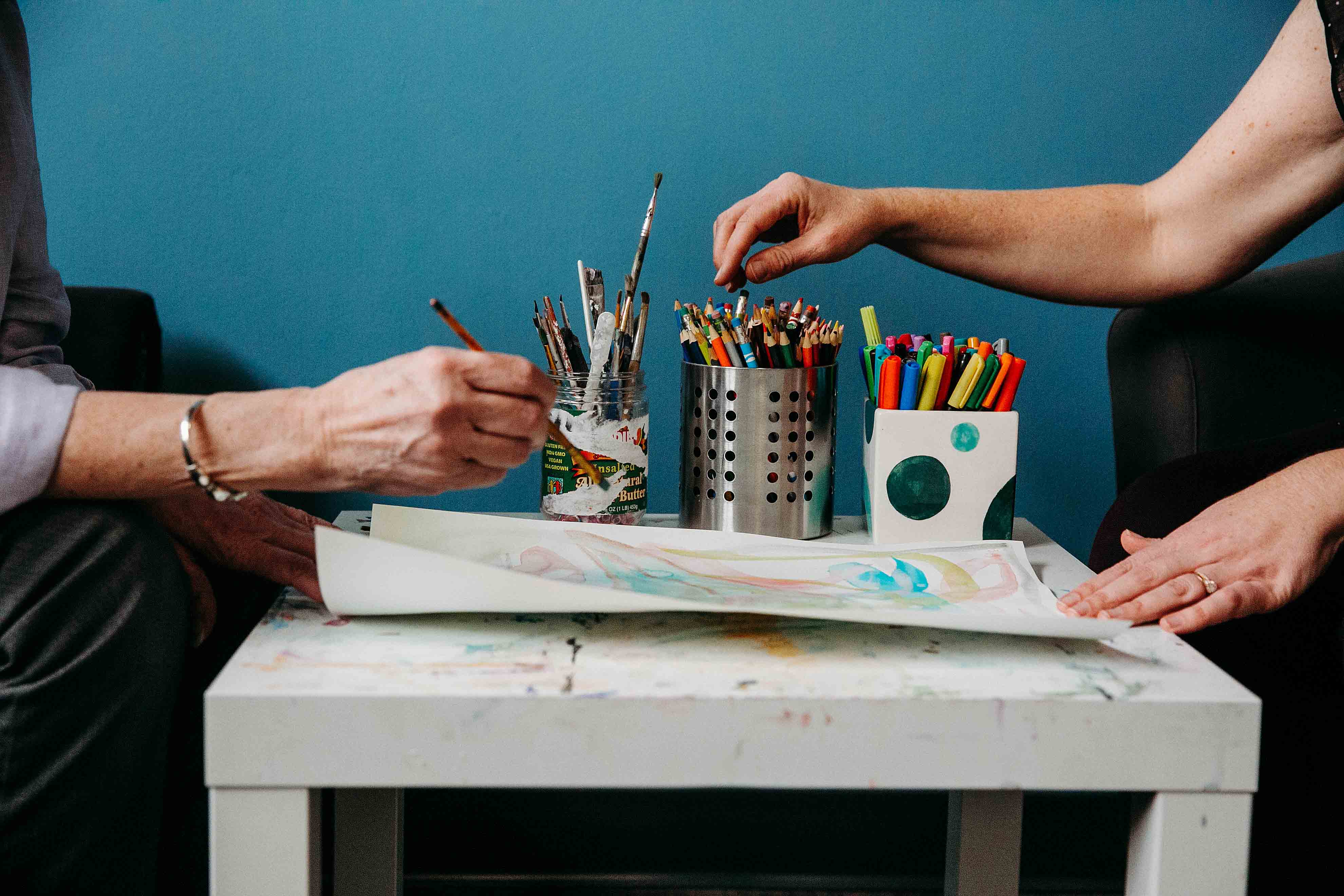
At The Artful Life, we believe creativity can help us better understand ourselves, connect with others, and imagine the possibility of change. During a session, you might use various art materials to make drawings, paintings, collages or sculpted pieces.
While traditional therapy is useful, there are certainly other modalities that can help folks find better ways of expressing, exploring, and better understand their feelings. In this article, we’ll look at what art therapy actually is, how it works alongside talk therapy , and why you definitely don’t need to consider yourself an artist to benefit from it.
Art therapy brings the creative process into the therapeutic relationship.
An art therapy session might include drawing, painting, collage, clay, or other visual art materials. But visual art is only one way creativity can become part of therapy.
Our broader approach includes expressive and creative arts therapies, which can incorporate movement, music, drama, writing, storytelling, play, imagery, and metaphor, depending on the therapist’s training and what feels helpful to the client.
Whatever the creative modality, the goal isn’t to create something beautiful or perform something well. It’s to use the creative process to explore what you’re experiencing in a different way.
Creative exploration can often lead to increased insight. When you can visualize or make sense of what’s happening inside of you, it can become easier to articulate how you feel, describe patterns, and understand what you need. You may begin to notice what triggers your anxiety, understand why a relationship keeps bringing up the same feelings, or find a way to express an experience you haven’t been able to put into words.
Greater self-awareness can lead to making more intentional choices in how you respond to your emotions, your relationships, and the challenges in your life.
When we’re anxious, overwhelmed, grieving, struggling in a relationship, processing something painful, or simply trying to understand ourselves better, our experiences don’t always arrive in neatly organized sentences.
Sometimes they show up as an image. Other times it surfaces as a memory. Or even a sensation in the body, or the visualization of a color. Or simply a feeling we haven’t figured out how to describe yet.
The arts can become a gateway into finding words.
Creating something can give us enough distance from an experience to see it differently. Something that felt difficult to explain may become a little easier to notice and eventually talk about.
Art doesn’t have to replace talking in therapy. It just gives us another place to begin.
If you’ve never tried art therapy, you might be wondering what happens once you’re actually sitting in the room with a therapist and a bunch of art supplies.
The answer is: it depends on you.
Art therapy is collaborative. Your therapist might invite you to try something creative, or an idea may come up naturally during a conversation.
You might choose images for a collage to explore a relationship. You might use color or lines to express what anxiety feels like in your body. You might create something that represents where you are now or where you’d like to be.
Sometimes the process is structured. Other times it’s much more open-ended. And yes, there’s usually plenty of talking.
Together, you and your therapist might notice what came up while you were creating, what surprised you, or what connections you see.
A trained art therapist isn’t there to look at your artwork and tell you what it means.
The meaning belongs to you. The therapist is there to help you explore it.

Not at all - though it is the most common asked question our team hears! Rest assured, you don’t need to know how to draw, have experience making art, or create something beautiful.
In art therapy, we’re much more interested in the process than the product. Perfection has no place here. Thank goodness!
A scribble can be useful. So can tearing paper, moving paint around a page, arranging images, pounding clay, or choosing a color that seems to match how you feel.
There’s no right way to do it and nothing you need to prove. You’re simply being invited to explore.
We believe the relationship between a client and therapist is at the heart of good therapy.
Creativity gives us another way to build that relationship. As trust develops, you may feel safer trying something unfamiliar or expressing something that feels difficult to talk about.
Over time, we see a few relationships developing at once: the relationship between you and your therapist, your relationship with the creative process, and through both, a deeper relationship with yourself.
That’s an important part of how we approach therapy. We’re not simply giving someone an art project. We’re using creativity as another way to connect.

At The Artful Life, we believe the first step toward change is being able to imagine the possibility of change. That’s a big part of what creativity offers us.
Creativity allows us to become curious, look at an experience differently, and consider possibilities we may not have seen before. And in art therapy, you don’t have to do that alone.
Over time, understanding yourself differently can open up new possibilities for how you communicate, how you relate to others, how you respond to difficult emotions, and how you move through your life.
That’s what we mean when we invite our clients to “Imagine a more artful life.” It isn’t about making more art. It’s about using creativity, curiosity, and connection to imagine what might be possible for you and beginning to make meaningful changes toward it.
Curious about whether art therapy might be right for you? Learn more about our Art Therapy services or inquire about becoming a client to connect with our team.
Lorem ipsum dolor sit amet, consectetur adipiscing elit. Suspendisse varius enim in eros elementum tristique.
New Client Inquiry